Ultimate Guide: How to Use the Concrete & Cement Calculator
Accurately estimating construction materials is a critical step in any building project. A slight miscalculation can result in material shortages mid-project, or conversely, excessive waste that drains your budget. Our advanced Cement Calculator and concrete calculator simplifies this entire process for contractors, civil engineers, and homeowners.
Whether you're pouring a new foundation, building brick walls, or finishing walls with plaster, dealing with the fundamental question of "how many cement bags required?" is no longer a guessing game. By utilizing precise, engineering-grade formulas—specifically wet-to-dry volume conversion factors—this construction material calculator ensures India-focused precision for your exact project geometry and desired mix ratio. It even serves as an incredibly accurate rcc roof cost calculator when planning your slab casting.
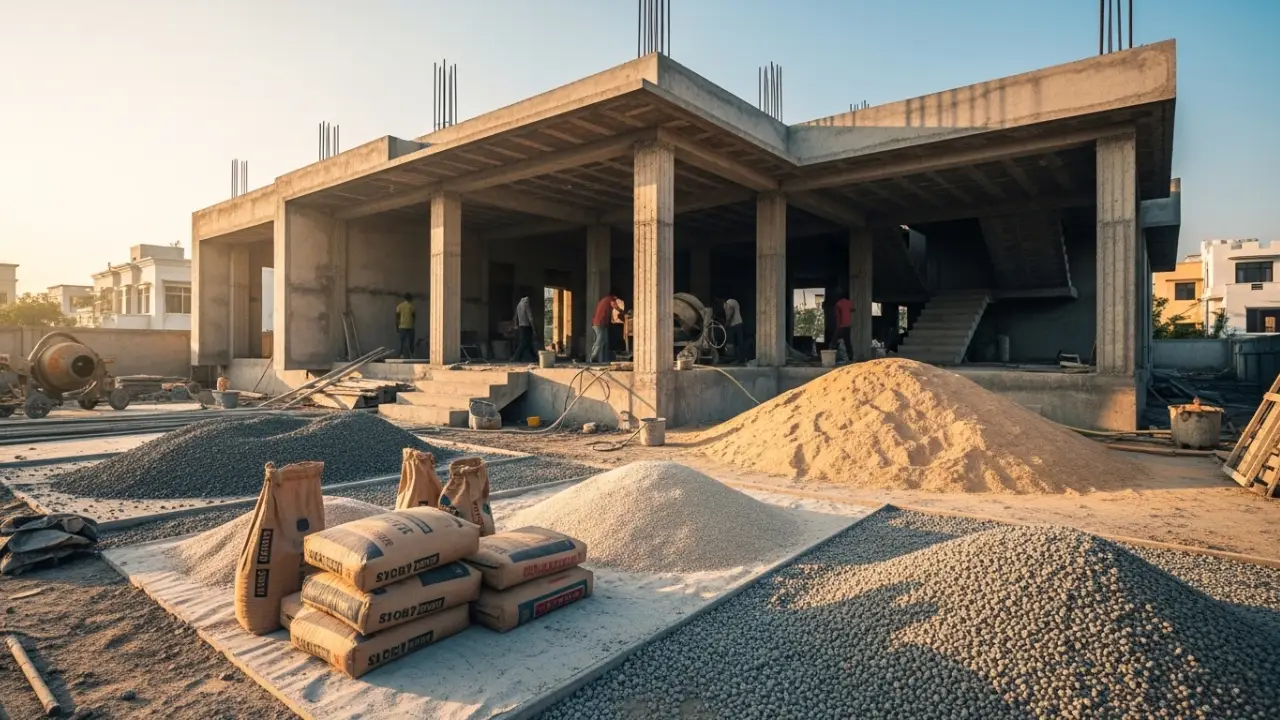
What is a Cement Calculator?
A cement sand aggregate calculator (also widely known as a concrete mix calculator or sand and cement calculator) is an online construction estimation tool that processes the physical dimensions of a structural element alongside the intended concrete mix ratio to generate accurate consumption requirements.
When you combine cement, sand (fine aggregate), crushed stone (coarse aggregate), and water, the mixture shrinks in volume because the tiny particles of cement and sand fill the natural voids existing within the larger chunks of aggregate. The original "dry" state of these individual powders and stones occupies significantly more physical space than the final hardened "wet" block of concrete.
Consequently, to build 1 cubic meter of solid concrete, you must purchase more than 1 cubic meter of dry raw material. A robust cement calculation formula inherently factors in this 'wet volume to dry volume' shrinkage.
The Golden Rule of Civil Estimation
Dry Volume of Concrete = Wet Volume × 1.54
Dry Volume of Mortar (Plaster/Brickwork) = Wet Volume × 1.33
The dry volume multiplication factor accounts for the 54% or 33% extra dry material you must compensate for prior to adding water.Decoding Concrete Mix Ratios
A concrete mix ratio acts as the overarching recipe for your structural integrity. It is always specified in the format Cement : Sand : Aggregate. The grade of concrete dictates the required ratio.
| Concrete Grade | Mix Ratio (C : S : A) | Primary Application |
|---|---|---|
| M10 | 1 : 3 : 6 | PCC (Plain Cement Concrete), unreinforced sub-base leveling |
| M15 | 1 : 2 : 4 | Non-structural foundation works, pavements, driveways |
| M20 | 1 : 1.5 : 3 | Standard residential RCC works (slabs, beams, columns) |
| M25 | 1 : 1 : 2 | Heavy load bearing columns, commercial heavy structures |
For application types where large stones are excluded—such as brickwork mortar or surface plastering—the ratio only includes Cement and Sand (e.g., 1:4 or 1:6).
The Concrete Calculation Formula Explained (Step-by-Step)
Let's manually derive how the tool operates, evaluating how much material is required for a standard roof slab with an area of 100 sq.ft and thickness of 5 inches using M20 (1:1.5:3) concrete.
Step 1: Calculate Wet Volume
- Area = 100 sq.ft
- Thickness = 5 inches = 0.416 feet
- Wet Volume = 100 × 0.416 = 41.66 cubic feet (cft)
- Convert cft to Cubic Meters (m³) = 41.66 × 0.0283 = 1.18 m³
Step 2: Convert to Dry Volume
- Dry Volume = Wet Volume × 1.54
- Dry Volume = 1.18 × 1.54 = 1.817 m³
Step 3: Extract the Parts
The M20 ratio is 1:1.5:3. By summing the elements, we yield the total parts of the composition.
- Total Ratio = 1 + 1.5 + 3 = 5.5 parts
Step 4: Resolve Cement Requirement
- Cement Volume = (Cement Part / Total Parts) × Dry Volume
- Cement Volume = (1 / 5.5) × 1.817 = 0.33 m³
The standard volume of a 50 kg cement bag is universally recognized as 0.0347 cubic meters.
- Cement Bags = 0.33 / 0.0347 = 9.5 Bags (Round up to 10)
Step 5: Resolve Sand & Aggregate Requirement
Similarly, we solve for fine and coarse aggregates. The sand component represents 1.5 parts, whereas aggregate represents 3 parts.
- Sand Volume (m³) = (1.5 / 5.5) × 1.817 = 0.495 m³ (or ~17.5 cft)
- Aggregate Volume (m³) = (3 / 5.5) × 1.817 = 0.99 m³ (or ~35 cft)
Our automated calculator effortlessly executes these conversion matrices underneath a simple, responsive interface while also tracking the financial liability resulting from current Indian market prices (₹420/bag of cement on average).
Tips for Accurate Material Estimation
Factor in Material Wastage
Labor inefficiencies during pouring, transit spillage, and site topography irregularities inevitably yield waste. By default, our construction material calculator India applies a 5% wastage buffer which guarantees you aren't caught off guard needing half a bag on the final day of casting.
Adjust Localized Pricing
Building costs vary dramatically. Sand procured in Kerala holds a vastly different market price compared to Uttar Pradesh due to regional mining restrictions and transport overhead. Always expand the "Advanced Market Settings" widget to align the financial estimator directly with quotes from your local hardware supplier.
Frequently Asked Questions (FAQs)
1. Wet Volume = 1 m³
2. Dry Volume = 1 × 1.54 = 1.54 m³
3. Cement Volume = (Cement Ratio / Total Ratio) × 1.54
4. Cement Bags = Cement Volume / 0.0347
For M20 grade (1:1.5:3), total ratio = 5.5, meaning it will require approximately 8 bags of cement per cubic meter.
Engineering Pro-Tips for Cement Calculation
- Wastage Buffer: Always include 5-7% extra material in your procurement order. On-site handling, transit spills, and surface irregularities often consume more than the theoretical volume.
- Cement Freshness: Never use cement that is older than 3 months. Cement loses approximately 20% of its strength after 3 months of storage due to atmospheric moisture absorption.
- Curing Period: For maximum structural integrity, ensure continuous water curing for at least 7 to 10 days. Improper curing can lead to a 50% reduction in the expected strength of the concrete.
- Sand Sifting: For plastering work, always use a fine sieve to remove pebbles and clay lumps from the sand. This prevents "map cracking" and ensures a smooth, premium finish.