About Concrete Calculator
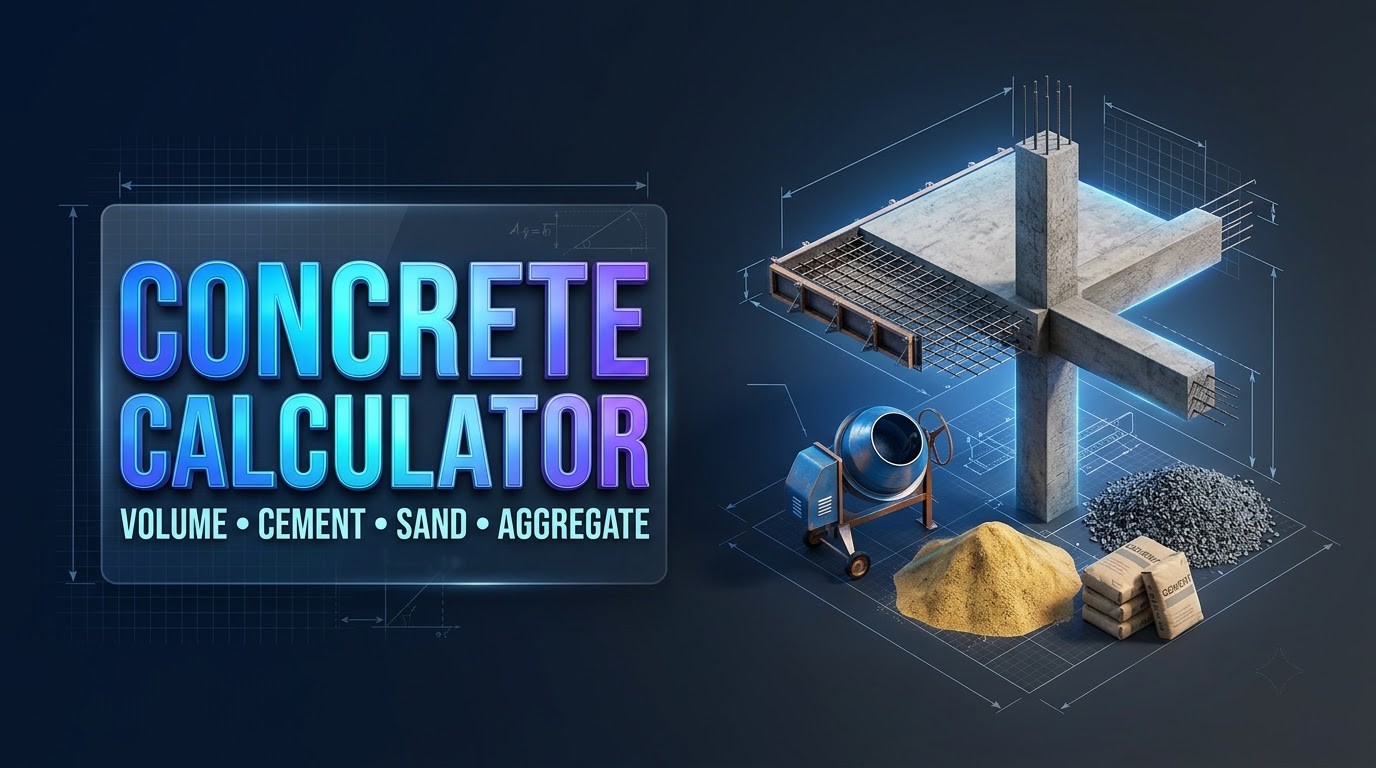
Planning concrete work for your house, foundation, roof, floor, or other construction project? Our Concrete Calculator helps you estimate the amount of concrete, cement, sand, coarse aggregate (gitti), and water required for your work. It also helps you calculate material costs before purchasing construction materials.
This online Concrete Volume Calculator is useful for homeowners, builders, contractors, and civil engineers. You can calculate concrete requirements for RCC slabs, footings, beams, columns, floor beds, and other concrete structures. Instead of calculating everything manually, enter your measurements to get an estimated concrete quantity and material breakdown.
Select the type of concrete structure and choose your preferred measurement unit. You can enter dimensions in feet and inches, meters, centimeters, or millimeters. Select a concrete grade such as M10, M15, or M20, or enter the mix proportions for a custom design mix. You can also enter local material prices to estimate the total concrete material cost.
How to Calculate Concrete Volume
Before calculating cement, sand, and aggregate, you need to find the total concrete volume required for your construction work. Concrete volume depends on the length, width, and thickness or depth of the structure. Use the correct dimensions to get a reliable estimate of the concrete quantity.
For rectangular structures such as slabs, beams, footings, and rectangular columns, use this simple concrete volume formula:
Rectangular Concrete Volume Formula
Volume = Length × Width × Height (or Thickness) × Number of Structures
For circular columns and other cylindrical concrete structures, calculate the volume using the radius and height:
Circular Concrete Volume Formula
Volume = π × Radius × Radius × Height × Number of Structures
Our concrete calculator converts your measurements into the required units before calculating the concrete volume. It also accounts for the selected wastage percentage and dry volume factor when estimating cement, sand, and aggregate requirements.
How Much Cement, Sand and Aggregate Are Required for Concrete?
Knowing the concrete volume is only the first step. You also need to calculate the quantity of cement, sand, and coarse aggregate required to prepare the concrete mix. These materials are usually measured separately when concrete is mixed at a construction site.
The volume of dry materials is generally higher than the finished wet concrete volume because cement, sand, and aggregates contain spaces between their particles. A commonly used calculation takes the dry volume as approximately 1.54 times the wet concrete volume. This factor is an estimate and may vary depending on the materials and mix proportions.
For a basic material estimate, first calculate the wet concrete volume. Add the selected wastage percentage and then apply the dry volume factor:
Wet Volume to Dry Volume Calculation
Final Concrete Volume = Wet Volume × (1 + Wastage % / 100)
Dry Volume = Final Concrete Volume × 1.54
After calculating the dry volume, divide it according to the selected concrete mix ratio. The mix ratio determines the proportion of cement, sand, and coarse aggregate in the concrete.
- Cement Volume = (Cement Ratio / Total Mix Ratio) × Dry Volume
- Cement Weight (kg) = Cement Volume × 1440 kg/m³ (approximate density)
- Cement Bags = Cement Weight / 50 kg
- Sand Volume (m³ / CFT) = (Sand Ratio / Total Mix Ratio) × Dry Volume
- Aggregate Volume (m³ / CFT) = (Aggregate Ratio / Total Mix Ratio) × Dry Volume
Use these quantities as an estimate for material planning. Actual consumption can change based on moisture content, aggregate size, mix design, site conditions, and construction methods.
Concrete Mix Ratios for Different Grades
The concrete grade indicates its specified compressive strength. Concrete mix proportions depend on the grade, materials, and construction requirements. Nominal mixes use fixed proportions, while design mixes are prepared based on the required strength and material properties.
The following table shows commonly referenced nominal mix proportions and typical uses. For structural work, always follow the approved structural drawings and concrete mix specifications.
| Concrete Grade | Mix Ratio (C : S : A) | Characteristic Strength (28 Days) | Common Application |
|---|---|---|---|
| M5 | 1 : 5 : 10 | 5 N/mm² (MPa) | Levelling and non-structural concrete work |
| M7.5 | 1 : 4 : 8 | 7.5 N/mm² (MPa) | Foundation bedding and base preparation |
| M10 | 1 : 3 : 6 | 10 N/mm² (MPa) | Plain cement concrete (PCC) and pathways |
| M15 | 1 : 2 : 4 | 15 N/mm² (MPa) | General PCC work and light-duty concrete applications |
| M20 | 1 : 1.5 : 3 | 20 N/mm² (MPa) | Common residential RCC applications, subject to design |
| M25 & Above | Design Mix | 25 N/mm² and above | Structural concrete for projects requiring specified strength |
Important Note on M25 and Higher Concrete Grades
M25, M30, M35, and higher concrete grades generally require a suitable design mix based on the project specifications and material properties. Cement, sand, aggregate, and water proportions should not be selected using an unverified ratio. Use an approved mix design and consult a qualified civil or structural engineer for load-bearing construction. Our calculator can help estimate quantities when you enter the mix proportions or material consumption specified for your project.
Concrete Calculation in Cubic Feet (CFT) and Cubic Meters (m³)
Concrete is commonly measured in cubic meters (m³) for structural work and ready-mix concrete orders. In many Indian construction markets, sand and coarse aggregate are also purchased in cubic feet (CFT) or brass. Converting between these units makes it easier to calculate quantities, compare supplier rates, and plan material purchases.
Concrete Measurement Unit Conversion
- 1 m³ = 35.3147 CFT
- 1 CFT = 0.028317 m³
- 1 Brass = 100 CFT = 2.8317 m³
- 1 Cement Bag (50 kg) ≈ 1.226 CFT ≈ 0.0347 m³
Typical Construction Material Transport
- Tractor Trolley: Capacity varies by trolley and loading
- 6-Wheeler Tipper: Capacity varies by body size and material
- 10-Wheeler Truck: Capacity varies by vehicle and permitted load
- Transit Mixer (RMC): Common capacities include 6 m³ to 8 m³
For accurate ordering, confirm the actual vehicle capacity with your supplier. The amount of sand, aggregate, or ready-mix concrete delivered may differ based on the vehicle size and local transport regulations.
Concrete Material Cost Estimation
Concrete material costs can vary from one location to another. Cement prices, sand availability, aggregate rates, transport charges, and supplier prices may change over time. Our Concrete Cost Calculator helps you estimate the material budget by entering the prices available in your area.
Enter the current price of each material to calculate the estimated cost of your concrete work:
- Cement Cost: Number of 50 kg cement bags multiplied by the price per bag.
- Sand Cost: Required sand quantity in CFT or m³ multiplied by the local sand rate.
- Aggregate Cost: Required coarse aggregate quantity in CFT or m³ multiplied by the local aggregate rate.
The calculator can help you compare material quantities and prepare a basic concrete budget before starting work. Update the prices with actual supplier rates for a more accurate estimate.
Note: This concrete material cost estimate does not include labour, reinforcement steel, shuttering or formwork, machinery, concrete pumping, transportation, or other construction expenses. For a broader house construction budget, use our House Construction Cost Calculator.
Concrete Calculator for Different Construction Work
Concrete is used for different parts of a building, and each structure requires its own measurements. Select the correct structure type and enter the dimensions to calculate the concrete volume and estimated materials needed for your project.
RCC Slab Concrete Calculator
Calculate concrete for roof slabs and floor slabs using the slab length, width, and thickness. Include the correct dimensions from your drawings to estimate concrete volume, cement, sand, and aggregate requirements.
Footing Concrete Calculator
Estimate concrete for isolated footings and rectangular foundation pads. Enter the footing length, width, depth, and number of footings to calculate the total concrete volume required for foundation work.
Beam Concrete Calculator
Calculate concrete for plinth beams, tie beams, lintel beams, and RCC beams. Enter the beam length, width, depth, and quantity to find the concrete volume. Use the dimensions shown in the structural drawings.
Column Concrete Calculator
Calculate concrete for square, rectangular, or circular columns. Enter the column dimensions, height, and number of columns to estimate the total concrete required for vertical structural members.
Floor Concrete Calculator
Estimate concrete for ground floors, floor bases, pathways, and pavement work. Enter the floor area and concrete thickness to calculate the required volume for your flooring or outdoor project.
Custom Concrete Volume Calculator
If you already know the concrete volume from your construction drawing or site measurement, enter the total quantity directly. Calculate cement, sand, aggregate, and estimated material costs using your selected mix ratio.