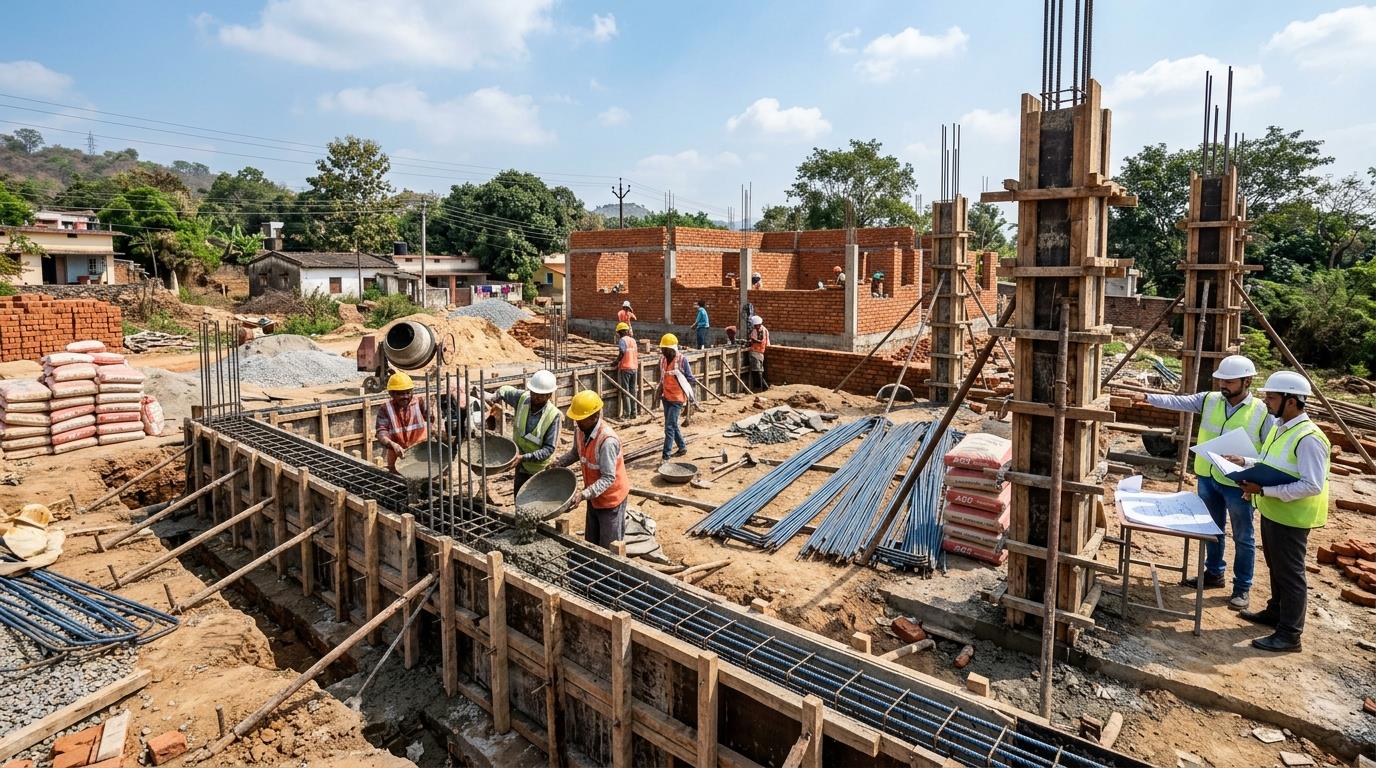
When building your dream home in India, getting the concrete mix ratio right can make all the difference between a structure that lasts generations and one that needs frequent repairs. This detailed concrete mix ratio chart covers M5, M7.5, M10, M15, M20, M25, and M30 grades with practical advice for homeowners and builders across Jharkhand, Bihar, and other states.
Whether you're planning a small 800 sq.ft house or a spacious duplex, understanding the right concrete grade helps control costs while ensuring safety and longevity. Let's dive deep into everything you need to know about concrete mix proportion, cement sand aggregate ratio, and how to choose the perfect grade for your project.
Quick Summary Box
What is concrete grade? The 'M' stands for Mix and the number indicates compressive strength in N/mm² at 28 days.
Most commonly used concrete grade for houses: M20 and M25.
Difference between M20 and M25: M25 is stronger with higher cement content.
Quick reference: M15 (1:2:4), M20 (1:1.5:3), M25 (1:1:2)
What is Concrete Mix Ratio?
Concrete mix ratio is the proportion of cement, fine aggregates (sand), and coarse aggregates used to produce concrete of desired strength. These ratios are critical because they determine workability, strength, durability, and final cost of your construction.
In Indian residential projects, we mostly use nominal mixes for smaller homes and design mixes for bigger structures. The right concrete mix proportion saves money and prevents future structural issues like cracks or seepage, which are common complaints in many homes built without proper planning.
Understanding Concrete Grades
Concrete grades are designated by the letter M followed by a number. This number represents the characteristic compressive strength of 150mm concrete cubes after 28 days of curing. Higher numbers mean stronger concrete suitable for greater loads.
For most single and double storey homes in India, grades between M15 to M30 are sufficient. Using higher than necessary grades unnecessarily increases your budget while lower grades can compromise safety.
Complete Concrete Grade Chart (M5 to M30)
| Grade | Concrete Mix Ratio | Cement : Sand : Aggregate | Strength (N/mm²) |
|---|---|---|---|
| M5 | Very Lean | 1:5:10 | 5 |
| M7.5 | Lean | 1:4:8 | 7.5 |
| M10 | Lean | 1:3:6 | 10 |
| M15 | Nominal | 1:2:4 | 15 |
| M20 | Standard | 1:1.5:3 | 20 |
| M25 | Standard | 1:1:2 | 25 |
| M30 | Design Mix | Based on design | 30 |
M5 Concrete Ratio
M5 concrete ratio of 1:5:10 is the weakest mix. It's mainly used for plain cement concrete (PCC) bedding under foundations or for mass concreting where high strength is not required. In rural house construction, this grade helps create a stable base before starting actual foundation work.
M7.5 Concrete Ratio
With a 1:4:8 cement sand aggregate ratio, M7.5 offers slightly better strength. It's suitable for non-structural works like pathways, backfilling, or as a base for flooring in low-budget projects.
M10 Concrete Ratio
The 1:3:6 mix for M10 is commonly used for simple foundations in areas with good soil bearing capacity. Many small independent houses in smaller towns still use this grade for PCC work.
M15 Concrete Ratio
The m15 concrete ratio of 1:2:4 is quite popular for economical construction. It's widely used for ground floor PCC, mass concrete, and non-structural members. However, it is generally not recommended for reinforced cement concrete (RCC) work in load-bearing structures.
M20 Concrete Ratio
The m20 concrete ratio (1:1.5:3) is the most widely used grade in Indian residential construction. It provides a perfect balance of strength and economy for columns, beams, and roof slabs in G+1 and G+2 buildings. For a typical 1000-1500 sq.ft home, M20 works excellently in most conditions.
M25 Concrete Ratio
The m25 concrete ratio of 1:1:2 delivers higher strength and better performance in exposed conditions. Many engineers now recommend M25 for roof slabs and water tanks due to its superior crack resistance and durability.
M30 Concrete Ratio
M30 is a design mix where the exact concrete mix proportion is calculated by a structural engineer based on site conditions, loads, and exposure. It is used in multi-storey buildings or where higher safety factors are needed.
Concrete Grade Comparison Table
| Grade | Strength | Approx. Cost/m³ (INR) | Best For |
|---|---|---|---|
| M15 | 15 MPa | 4200-4800 | PCC, Flooring |
| M20 | 20 MPa | 5200-5800 | General RCC |
| M25 | 25 MPa | 5800-6500 | Slabs, Critical Members |
| M30 | 30 MPa | 6800-7800 | Heavy Structures |
Typical Uses of Different Concrete Grades
Used for non-structural elements like PCC bed, flooring, pathways, and simple foundations.
Used for all RCC work including columns, beams, slabs, and foundations in modern homes.
Which Concrete Grade is Best for House Construction?
For most Indian homes, M20 remains the sweet spot. However, many forward-thinking builders are now using M25 for slabs even in normal residential projects. The choice ultimately depends on your soil report, number of floors, and local climate conditions.
M20 vs M25 Concrete
The main difference lies in strength and cement content. M25 offers better performance in water-prone areas and has higher resistance to weathering. The cost difference is usually 10-15%, which is worth it for long-term peace of mind.
Common Concrete Mixing Mistakes to Avoid
- Adding too much water – this reduces final strength significantly.
- Using unwashed sand or aggregates containing clay and silt.
- Inadequate mixing time leading to inconsistent batches.
- Poor curing – concrete needs proper moisture for at least 14 days.
- Ignoring slump test before pouring.
Practical Indian Construction Examples
Example 1: A 1100 sq.ft single-storey house near Ranchi used M20 concrete for all RCC work. Total concrete quantity was 38 cubic meters costing approximately ₹2.1 lakhs. The owner saved around ₹35,000 by choosing M20 over M25 while maintaining good structural integrity.
Example 2: A 2400 sq.ft duplex in suburban Jharkhand opted for M25 in roof slabs and M20 for columns and beams. The additional investment of ₹45,000 resulted in a much stronger terrace that shows no signs of seepage even after three monsoons.
Example 3: A builder in Bihar used M15 for PCC and M25 throughout the superstructure for a 30x40 plot house. This strategic mix helped them deliver a strong home while keeping the overall concrete cost under ₹3.8 lakhs.
Expert Recommendations
Always get your soil tested before finalizing grades. Use our Construction Cost Calculator and Cement Calculator to estimate quantities accurately. For best results, consider ready mix concrete (RMC) for uniformity, especially for slabs. Proper curing and quality aggregates are as important as the right concrete grade ratio.
Conclusion
Understanding this concrete ratio chart empowers you to make better decisions for your home construction project. Whether you choose M20 or M25, the key is consistency in mixing, proper curing, and following your structural engineer's advice. Building a strong home starts with the right foundation – both literally and figuratively.